
What Is Maragogype Coffee? The Elephant Bean — and the Hybrid It Made
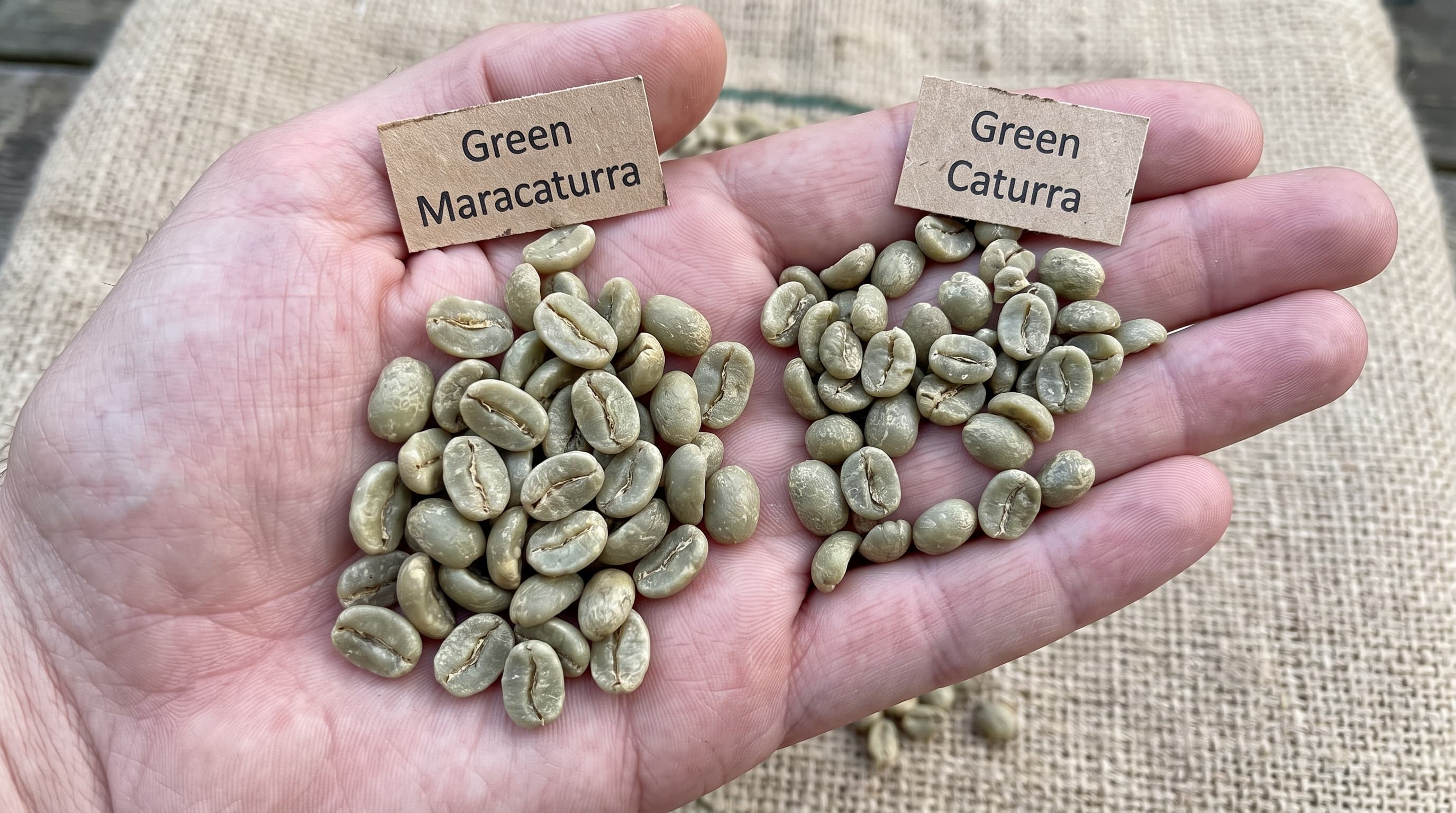
Pour a handful of Maracaturra into your palm next to a handful of almost anything else and the difference is comic. The beans are enormous — nearly double the size of what you're used to seeing, with deep center cuts and a heft that feels wrong for coffee.
That size comes from one ancestor in particular, and it comes with a catch. Big beans are a headache. They roast unevenly, they scorch if you rush them, and they've been quietly frustrating roasters for over a century.
We think this one is worth the trouble. Here's the coffee, and here's the family it came from.
What is Maragogype coffee?
Maragogype is a naturally occurring mutation of Typica, one of the two ancestral cultivars from which most of the world's arabica descends. It turned up near the town of Maragogipe in Bahia, Brazil, in the late nineteenth century, and it announced itself immediately: the plants were larger, the leaves were larger, and the beans were dramatically, unmistakably larger than anything growing around them.
The trade nicknamed it the Elephant Bean, and the name stuck.
For a while, size alone made it valuable. Green coffee is graded partly on screen size, and Maragogype sailed past every threshold. Buyers paid premiums for it on appearance.
But the economics never really worked. Maragogype plants are tall and sprawling, they take up considerable space, and they produce very little fruit for the room they occupy. A farmer growing Maragogype is giving up a lot of yield for those impressive beans. Over the twentieth century, most of the world's Maragogype was quietly pulled out and replaced with something more productive.
What survives today survives because someone decided the cup was worth it.
Why giant beans are a problem, not a selling point
Here's the part that rarely makes it onto a bag.
Large coffee beans are less dense than small ones. Heat has to travel farther to reach the center, and less dense material conducts it less efficiently. The practical result is that a big bean will happily cook on the outside while the inside is still catching up.
Get that wrong and you get the worst of both ends: scorched, papery notes from the surface layered over grassy underdevelopment from the core. The coffee tastes simultaneously overcooked and raw, which is exactly as unpleasant as it sounds.
This is why Maragogype and its descendants have a reputation among roasters for being finicky. It isn't superstition. It's a genuine thermal problem, and the bigger the bean, the worse it gets.
Enter Maracaturra
Somewhere along the way — most accounts place it in Nicaragua — someone crossed Maragogype with Caturra, and got something more interesting than either parent.
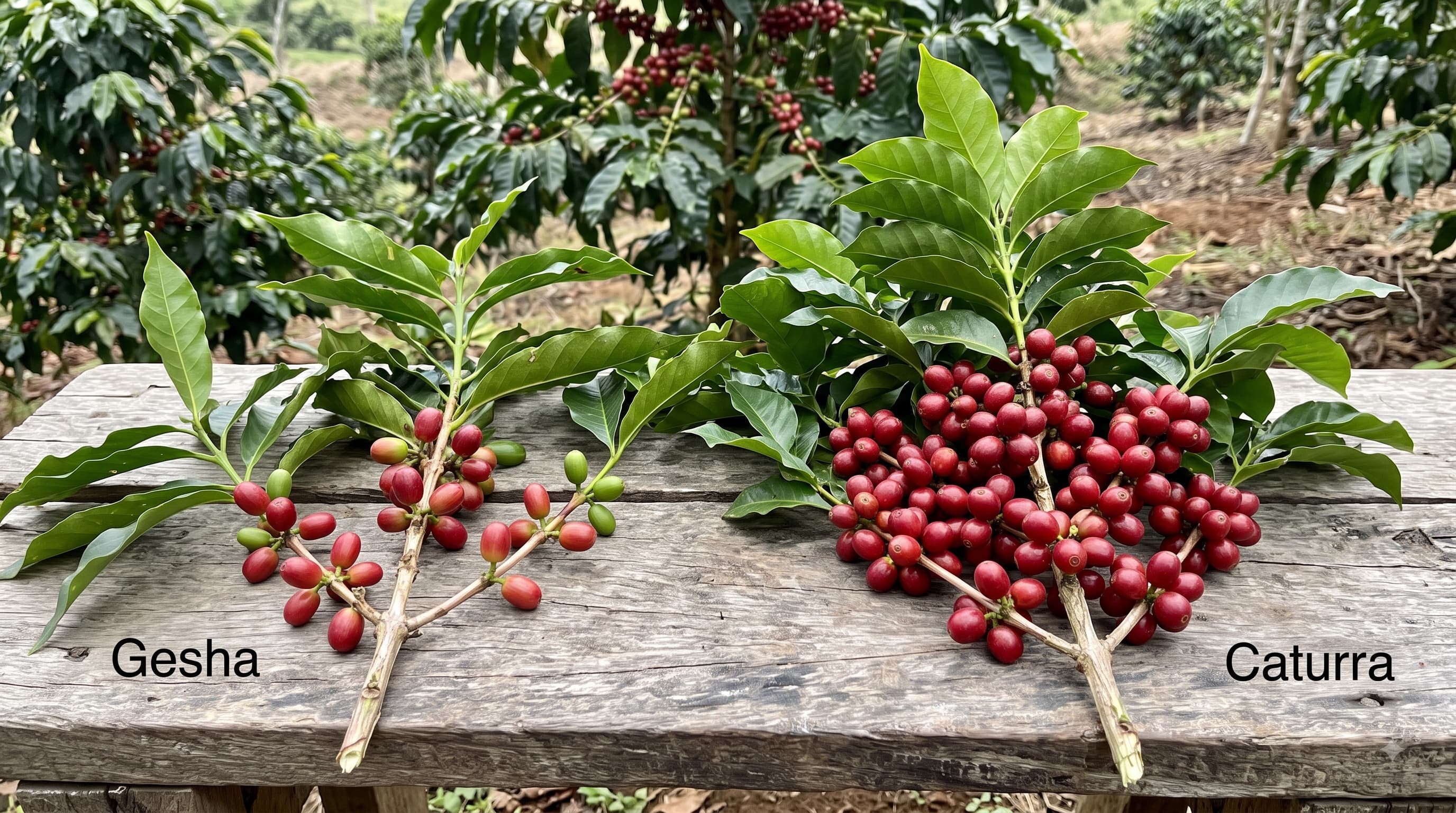
Caturra is the opposite of Maragogype in almost every respect. It's a natural mutation of Bourbon, discovered in Brazil, and its defining trait is dwarfism: short, compact plants that pack tightly onto a hillside and produce generously. Caturra is one of the great workhorses of Central American coffee. It's also the variety behind our Guatemala La Bella, if you've had that one.
Maracaturra is the hybrid — the Elephant Bean's size married to Caturra's compact frame. It's grown in pockets across Central America, mostly Nicaragua, El Salvador, and Guatemala, and it's rare enough that most people who drink coffee daily have never encountered it.
What earns it shelf space in specialty coffee isn't the size. It's the complexity. Maracaturra lots tend to be unusually layered and fruit-forward — the kind of cup that keeps rearranging itself while you drink it.
Maracaturra from Monte de Oro

This is our second coffee from the Monte de Oro farm — the "Mountain of Gold" — in Guatemala's Acatenango region, and our second from producer Mario Alarcón.
We went back because of what that farm's volcanic ground does to acidity. Acatenango's soil is mineral-dense and sharply draining, and coffees grown in it tend to arrive with a clarity and a lift in the cup that's difficult to fake elsewhere. In a variety already predisposed toward complexity, that geology is an accelerant. It's the reason the citrus in this coffee reads as blood orange specifically — juicy and a little bitter at the edge — rather than generic brightness.
Mario processed this lot naturally, drying the cherries whole with the fruit intact. On a Maracaturra that decision cuts against the grain a little: naturals usually push a coffee toward jam and sweetness, and the risk is smothering the acidity that makes the variety worth growing. It didn't. The fruit sweetness arrived and the blood orange stayed exactly where it was.
The roasting problem — and what we did about it
Remember the thermal issue with big beans. This is where it stops being theory.
Our standard approach is low and slow: gentle heat, extended development, small batches. It's how we handle nearly everything, and on a coffee like our Gesha it's the right instinct — stay out of the way and let the bean speak.
That approach alone won't get you through a Maracaturra. Too little heat movement and the size differential wins; the surface runs ahead of the core no matter how patient you are.
So we changed one variable: airflow. Running higher airflow shifts more of the heat transfer from conduction — the drum surface touching the bean, which is what scorches — toward convection, hot air moving around and through the bed. Convective heat is gentler and far more even. It reaches the center of a large bean without punishing the outside.
Paired with a restrained heat application, that's what let us develop the milk chocolate sweetness fully enough to balance the acidity, without ever pushing the blood orange into sourness or flattening it into roast. It took more attempts than we'd like to admit.
What Maracaturra Monte de Oro tastes like

The opening is blood orange — juicy, bright, with that characteristic slight bitterness at the finish that separates it from lemon or grapefruit. Underneath it sits fresh cacao nib, drier and more savory than you'd expect, and then milk chocolate rounds the whole thing out. The finish is clean and sweet, closer to sugarcane than caramel.
Give it time to cool, though. Warm, it's a blood orange coffee with chocolate underneath. Cool, it opens into a whole spectrum — several distinct citrus notes rather than one, several registers of chocolate rather than one, and a soft floral lift at the very end that isn't there at all when the cup is hot.
At a glance
- Origin: Monte de Oro farm, Acatenango, Guatemala
- Producer: Mario Alarcón
- Variety: Maracaturra (Maragogype × Caturra)
- Process: Natural
- Roast: Light
- Tasting notes: Blood orange, milk chocolate, floral finish
- Format: 12 oz whole bean — $32
How to brew Maracaturra at home
We brew this one at 16:1 — slightly more water than we'd use on a denser coffee. Large, less dense beans give up their solubles more readily, and the wider ratio keeps the extraction from tipping into harshness while letting the sweetness carry.
You'll need: V60, filter, gooseneck kettle, scale, timer
- Coffee: 25 grams, ground medium-fine
- Water: 400 grams at 202°F
- Bloom. Pour 50 grams over the grounds and wait 45 seconds. That's a longer bloom than we'd normally recommend — naturals carry more gas, and rushing this stage will cost you evenness later.
- Main pour. Add the remaining 350 grams over 3 minutes, in slow, steady circles.
- Drawdown. Allow about 15 seconds for the bed to drain.
- Total brew time: 3 minutes 45 seconds.
One note on grinding: because the beans are so much larger than average, your grinder may need a slightly finer setting than the number you'd normally reach for. Trust the grounds, not the dial.
Its sister lot
Maracaturra isn't arriving alone. Mario sent us two lots this season, and the other is a Gesha Monte de Oro — same farm, same producer, same natural process, same $32, and an entirely different experience: raspberry, lychee, black cherry, a strawberry cream finish.
They make an interesting pair precisely because they asked opposite things of us. The Gesha needed us to do as little as possible. The Maracaturra needed us to intervene.
Where to find them
Maracaturra from Monte de Oro will be available this September at both Lavender Coffee Boutique locations in Denver — Pearl Street and Cherry Hills Village — and online at lavendercb.com.
If you're deciding between the two, come try both at the bar. That's genuinely the best way to understand what a farm can do across two very different plants.
Both are small lots. When they're gone, they're gone.
**Disclaimer: The hero image is AI generated to illustrated the size of the maragogype coffee bean due to limited resource by our coffee farm.